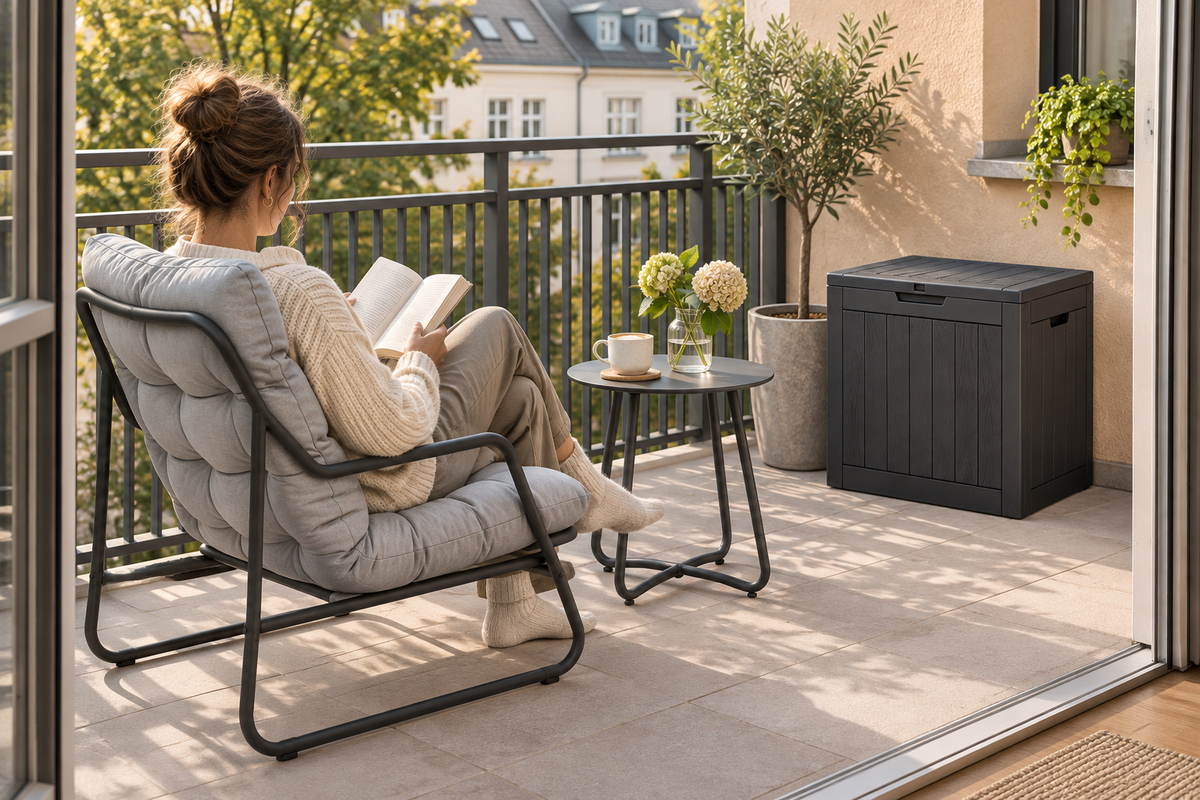
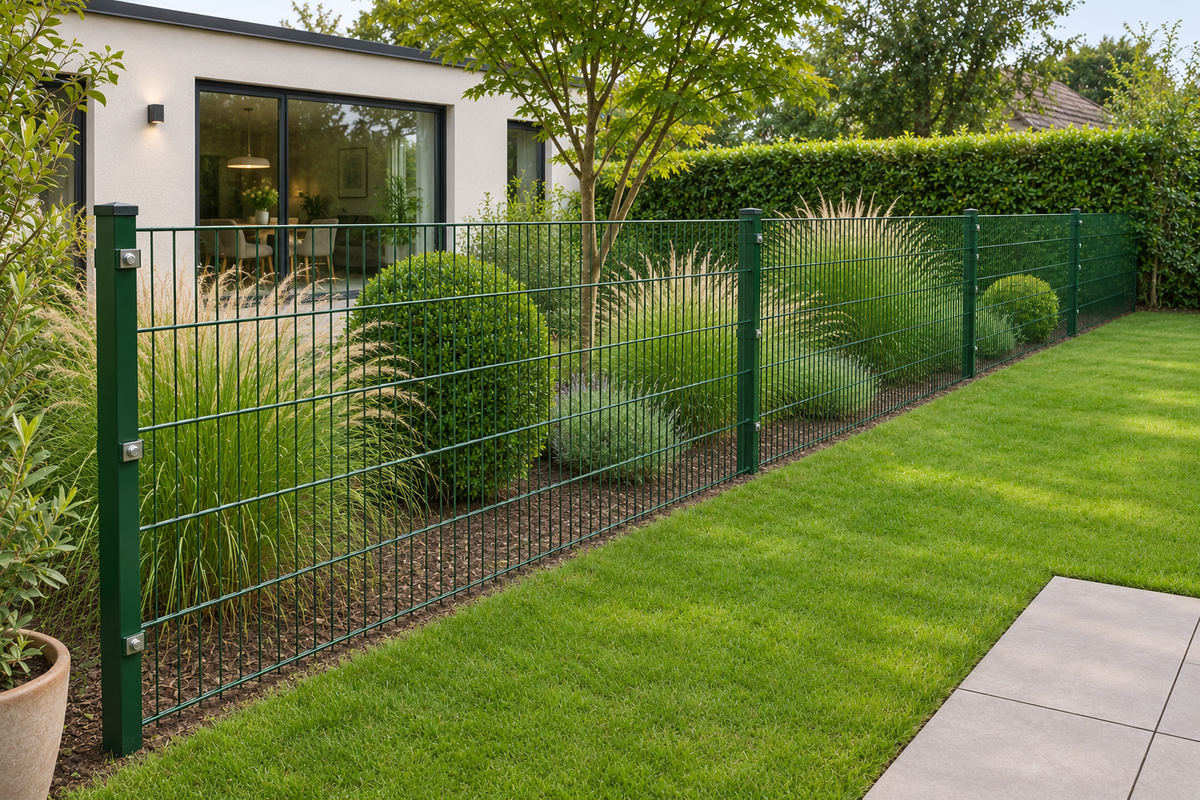
A garden feels right when it works for your everyday life. Cushions are easy to put away, there is enough room around the table and the bins can be wheeled out without a detour. Achieving this takes a sensible planning sequence rather than as much furniture as possible. This guide helps you work out what you need, check the important measurements and bring storage, seating and privacy screening together in a practical way.
1. Start with your everyday life, not the furniture catalogue
First, think about how you actually use your outdoor space. Do you have breakfast for two on the balcony, does the family regularly eat outside, or do you mainly want to put your feet up after work? Write down your two most important uses. Give them the best spots and arrange everything else around them.
Next, take stock: what will stay, what is missing and what currently gets in the way? Giving cushions, toys and garden accessories a permanent home can make a big difference. A large lounge set, on the other hand, is of little help if it makes the route to the house too narrow.
Think of your space as areas for sitting, storage and moving around. Even a small balcony needs a clear exit and room to open doors or lids. Mark possible footprints with masking tape or empty boxes. This often gives you a better sense than a drawing of whether your proposed layout will feel comfortable to use.
2. Measure your belongings and the available space separately
For a cushion storage box, you need two different sets of measurements: the size of the things you want to store and the space where the box will stand. Stack your cushions as you actually intend to store them. Measure the length, depth and height of the complete stack, including firm back cushions, thick seams and any parts that cannot be folded.
Compare this stack with the box's internal dimensions. The external dimensions only help you check the space it will occupy. The lid, wall thickness and structural features can reduce the usable room inside. The opening must also be large enough: an item may fit within the internal dimensions on paper yet still be awkward to put in.
Allow some room to get hold of your cushions and lift them out, rather than calculating a fit down to the last centimetre. However, a fixed allowance for every product would be misleading. The room you need depends on the shape, firmness and arrangement of your belongings.
Also note how far the lid can open and whether a windowsill, shelf or sloping wall sits above it. Include the door area when planning for cabinets and sheds. If an important internal or opening dimension is missing, ask before ordering. You cannot reliably work it out from the stated capacity in litres.
3. Choose a garden storage box by its shape and contents, then by capacity
Capacity is a useful guide to overall size. Whether your cushions will fit, however, depends on the individual internal dimensions. A tall box may offer plenty of storage but still be too short for a long lounger cushion. A lower, longer box may be a better shape for that particular job.
An example from the range makes the difference clear: Northwood offers 623 litres and internal dimensions of 145 × 68 × 62 cm. The 870-litre Ontario has internal dimensions of approximately 136.2 × 73.2 × 77.8 cm. Ontario is deeper and taller inside, while Northwood is longer. A rigid cushion measuring 140 cm in length would therefore not fit Ontario simply because its capacity is greater. Always check all three dimensions and the opening.
| Model | Nominal capacity | Internal dimensions (L × D × H) |
|---|---|---|
| Northwood | 623 L | 145 × 68 × 62 cm |
| Ontario | 870 L | ≈ 136.2 × 73.2 × 77.8 cm |
For smaller belongings, compact models are worth considering. Cubex offers 130 litres with external dimensions of 56 × 43 × 53 cm and an internal space of 53 × 35 × 50 cm. That serves a different purpose from storing long lounge cushions. Two small boxes can also be practical if you want to keep things within reach in two different places.
Next, compare materials, included items and ease of use. Will you open the box frequently? Is a lockable lid important? Do you also want to use it as a seat? Such features only apply when they are explicitly stated for the model you have chosen. Styled photographs do not automatically show what is included.
4. Plan storage for damp days too
A garden storage box should make everyday life easier, but it does not replace proper care of your textiles. Put cushions away clean and dry whenever possible. Moisture you put inside does not automatically disappear when you close the lid. Follow the instructions for both the box and the cushions.
Distinguish between weather-resistant, splash-resistant and watertight in product information. These terms are not interchangeable. What matters is the information for the specific model and the conditions for assembly and use. Do not rely solely on an atmospheric photograph taken in the rain.
Choose a location where you can easily reach and open the box. Check occasionally for dirt around the lid or dampness inside. For longer-term storage of delicate textiles, a suitable dry indoor space is often a simpler choice, unless their care instructions say otherwise.
5. Plan a garden shed or storage cabinet around your largest item
Start choosing a garden shed with your bulkiest item in mind: a lawnmower, bicycle, wheelbarrow or garden tool. Measure more than its footprint; include the width of handles, handlebars and attachments. Consider whether you can push it straight through the door or will need to turn it inside.
A shed's external footprint tells you little about how well you can use the space inside. Internal dimensions, the doorway, threshold and arrangement of your equipment are often more important. Begin by drawing large items as simple rectangles on a floor plan. You should be able to get frequently used items out without emptying the entire shed.
Before buying, check the assembly instructions and the requirements for the base, foundation and fixings. An included floor or floor frame does not automatically make every site suitable. The preparation needed and the items supplied depend on the model. Plan this work before delivery.
Include roof overhangs, opening doors and access for assembly when planning the space. Check the rules that apply to your location before committing to a site. The shed advisor can narrow down your choice, but a final check of the location and assembly requirements is still important.
6. Hide your bins without making them harder to use
A wheelie bin storage unit should make your entrance look tidier. Above all, though, it needs to fit the bins you actually use. Note their number, individual capacities and external dimensions, including handles and lids. The name of a storage unit alone is not enough to establish a fit.
Think through the route on collection day: can you remove each bin individually? Can the doors and bin lids open fully? Is there enough room in front to manoeuvre, and is the route to the street easy to use? Position the unit around the routine of a normal bin day, as well as how it looks.
For models such as Soraya or Vela, always compare the specific version. The number of bin spaces, dimensions, opening mechanism and included items can vary. Also check the assembly requirements for the base. A model that looks right only becomes a good solution when your bins remain easy to reach.
7. Decide first between dining, lounging and flexible seating
In photographs, garden furniture can look larger or more compact than it will on your own patio. Choose its purpose first: for shared meals, table and seat height and easy access to each place are important. For relaxing, focus instead on how the seats feel, the backrests and the arrangement of the individual pieces.
Plan for the number of people who regularly sit outside, adding flexible seating for guests if needed. A large set for occasional visits can take up more space than it earns in everyday use. Also consider whether you want to move the furniture easily for cleaning or to use the area differently.
For example, the Amber combination with a garden sofa, two garden armchairs and a rectangular garden table serves a different purpose from the Lara bistro set with two lounge chairs and a round side table. Check the specific version and the space required for both. Similar photographs or a shared series name do not automatically mean that the same items are included.
Next, compare the dimensions of your chosen combination with the area you have marked out. Pull chairs back as far as you would when standing up, and keep the route to the house clear. Check the actual size of the cushions when planning their storage. This makes seating and storage parts of one solution, rather than two purchases that turn out not to work together.
8. Create a calmer space with a clear layout
Repeating colours and choosing a small number of materials helps furniture, storage and fencing look as though they belong together. You do not have to buy everything from the same series. Often, repeating a base colour and limiting bold accents to a few places is enough.
Position the largest elements first. A shed, wheelie bin storage unit or large lounge set affects your routes more than a side table does. Arrange smaller furniture and plants afterwards. Keep storage close to the things it holds: a cushion box next to the seating is more likely to be used every day than one tucked far away.
Consider the sun and shade at the times you sit outside. Observe your space in the morning, at midday and in the evening before settling on a fixed layout. Think about whether you want a view of greenery from your seat and which areas you would prefer to screen. A small, usable area is usually more pleasant than a space filled from edge to edge.
9. Draw your fence route and gate before ordering quantities
Do not measure a fence only as a total length. Draw each straight section, every corner and your intended gate position. Mark existing walls, changes in ground level and places where fixing options are limited. The sketch does not have to be attractive; it needs to make the route clear.
For the 200-cm mesh panels used in the fence planner, the confirmed installation spacing is 2 m from post centre to post centre for each full panel bay. This spacing helps you divide up the route. A straight run of 6 m therefore corresponds to three full bays, provided it does not include a gate opening or a special connection. Any remaining lengths need separate planning.
The total length alone does not reliably tell you the complete number of posts and accessories required. Starts, ends, corners, gates and the chosen fixing method all affect the quantities. Panel and post heights and specifications must also be compatible. Use the parts list for your specific plan rather than adding together quantities from different examples.
Include the gate in your design from the start. Its position determines the fence lengths left on either side and how you will access the garden. Choose the clear opening width for the largest item that needs to pass through, and consider the opening direction. Also distinguish between a stated centre-to-centre measurement and the usable clear opening.
Before adding the fence planner's selection to your basket, compare its sketch with your measurements: are the sections, corners, gate and fixings correct? Then check the individual items. If there is a slope, an unusual connection or uncertainty about the foundations, get the plan clarified before ordering.
10. Add privacy screening where you actually need it
Start with the view you want to change: is it your patio seating area, a path along the boundary or the view of your bins? Screening one particular area is often enough. Screening the entire boundary, on the other hand, may require more material and a different structural assessment.
For privacy screening woven into mesh fencing, compare the dimensions of your chosen product with your fence and intended weave. Length, width, colour and fixings all need to work together. Do not calculate quantities from an example photograph alone, or assume the dimensions of another version apply without checking.
Privacy screening changes how wind acts on a fence. The existing posts, fixings and foundations must be suitable for the specific installation. Follow the product and assembly instructions and resolve any questions before buying. For a calmer overall appearance, you can coordinate the colour with your furniture or storage without treating every area in the same way.
11. Plan delivery and assembly as carefully as the purchase
Check the current shipping method and delivery estimate for the version you have selected. A small accessory and a large garden shed may arrive in different ways. Rely on the item-specific information rather than applying one general delivery time to the entire range.
For freight delivery, a telephone number where you can be reached is needed to arrange delivery. This is a delivery contact, not an offer of telephone support. Consider in advance whether the vehicle access, gate and route to the intended location are suitable for delivery and for carrying the packages afterwards. The agreed delivery terms specify how far the goods will be brought.
Read the assembly instructions before ordering whenever they are available. They show you which tools, preparations and helpers are required. Check explicitly whether a floor, fixings or other accessories are included. Finalise your shopping list only after checking these details.
Inspect the delivered parts before assembly. Keep the item and order numbers somewhere you can quickly find them if you have a question. If a part is missing or damaged, identify it using the instructions where possible. An overview photograph, a close-up and a legible part number help identify the issue. Photographs are required to assess damage; please use the designated service channel.
12. Finish by comparing two suitable options
If several products meet your requirements, you do not need to compare every detail across the whole range. Choose two or three serious candidates and check the same features side by side. For garden storage boxes, these are mainly internal dimensions, external dimensions, material and included items; for furniture, also check the exact combination and the space it needs.
As a final step, check the selected colour or version, current price and availability. The right model in the wrong combination will not solve your problem. Save your selection to the wishlist if you want to measure again. The best choice is not necessarily the largest product, but the solution that suits your everyday life without rearranging things, buying extras or improvising.
- What should this purchase make easier in everyday life?
- Do the contents, footprint and opening space fit?
- Have you checked the base, fixings and access?
- Are the selected version and included items right?
- Have you prepared for delivery and assembly?
Three example projects: turning measurements into a suitable choice
The following people and everyday situations are entirely fictional. Product dimensions and calculations are based on the linked shop information.
Fictional planning example
Nora's city balcony: making room for a compact box
Nora is planning a city balcony measuring 2.4 × 1.6 m. Beside her seating, she has kept an area of 90 × 60 cm clear. Her dry, stacked cushions measure 48 × 30 × 42 cm. She wants an accessible storage spot without filling the entire balcony with storage.

She considers the 130-litre Cubex: 56 × 43 × 53 cm outside and 53 × 35 × 50 cm inside. Comparing the measurements in the same axis order gives a calculated difference of 5 cm in length, 5 cm in depth and 8 cm in height. Within the marked area, the remaining space outside the box totals 34 cm in length and 17 cm in depth. Nora marks the outline before deciding.
- Cushion stack
- 48 × 30 × 42 cm
- Box internal dimensions
- 53 × 35 × 50 cm
- Total calculated clearance
- 5 × 5 × 8 cm
Check before deciding
- Measure the cushions as a real stack, not just a single cushion.
- Keep the balcony door and route through the space clear.
- Check the opening and the space above and behind the open lid.
The calculation identifies a possible candidate. It does not confirm the size of the opening or that the door or lid can swing freely. The remaining centimetres are total differences, not guaranteed clearance on every side. Firm seams and the actual shape of the stack also need to be considered.
Fictional planning example
The Meyer family's patio: long cushions matter more than extra litres
The Meyer family is planning a patio measuring 5 × 3.5 m. Their long, unfolded cushions form a stack of 140 × 50 × 48 cm. First, the family looks for a box to hold these specific cushions. Only then do they consider where it could stand within easy reach beside the furniture.

According to the currently checked product description, the 623-litre Northwood has internal dimensions of 145 × 68 × 62 cm. Compared with the cushion stack, that gives a total calculated difference of 5 × 18 × 14 cm. Ontario offers 870 litres, but its internal length is only approximately 136.2 cm; the other internal dimensions are approximately 73.2 × 77.8 cm. That length is not enough for the intended straight storage arrangement. For the Meyers, a higher capacity alone is therefore not a sufficient reason to choose it.
- Cushion stack
- 140 × 50 × 48 cm
- Box internal dimensions
- 145 × 68 × 62 cm
- Total calculated clearance
- 5 × 18 × 14 cm
Check before deciding
- Compare all three internal dimensions with the complete stack.
- Mark the footprint using the external dimensions.
- Allow for the route past the box, accessible handles and space to open the lid.
Northwood remains a candidate that fits on paper, rather than a guaranteed fit. The family must also check the opening, internal contours and actual cushion shape. The patio's overall size does not prove that a clear spot is available. This example keeps the assumed cushion dimensions unchanged and does not rely on folding them differently.
Fictional planning example
Mira's U-shaped fence: plan the sections before the parts list
Mira is planning a U-shaped fence with three straight sections, each 4 m long. That makes 12 m in total, with two corners and no gate. She draws each section separately and marks the two changes of direction. For this initial calculation, she works with the confirmed centre-to-centre post spacing.

With an installation spacing of 2 m for each full 200-cm mesh panel bay, the calculation gives two bays per 4-m section and six full bays in total. Mira uses those six bays as the starting point for her preliminary plan. She then enters the three sections, two corners and the option 'no gate' in the fence planner and compares the generated sketch with her drawing.
- Straight sections
- 4 + 4 + 4 m
- Corners
- 2
- Full panel bays
- 6
Check before deciding
- Measure each straight section again on site.
- Clearly mark the start, end and both corners.
- Choose a fence height, colour and fixing method suitable for the site.
- Check the sketch and individual basket items before ordering.
Six bays do not imply a fixed number of posts or accessories. The required corner solution, posts, fixings and foundations depend on the chosen system and site. This simple example does not include slopes or special connections. The fence planner helps put the components together, but it does not replace checks of the site and assembly requirements.
Frequently asked questions about garden planning
How do I find the right size of cushion storage box?
Measure the length, depth and height of your cushions as a complete stack. Compare these measurements with the usable internal dimensions, allowing for the opening and room to get hold of the cushions. Check the external dimensions separately for the location. The size finder helps you shortlist options; clarify any missing information before buying.
Is a garden storage box with a greater capacity automatically longer?
No. Capacity is spread across length, depth and height. For example, the 623-litre Northwood has an internal length of 145 cm, while the 870-litre Ontario measures approximately 136.2 cm inside. For a long cushion that cannot be folded, the lower-capacity box may therefore have the more suitable shape. The individual dimensions and the opening are what matter.
Can I leave garden cushions in the box all year round?
That depends on the box's properties, the cushions' care instructions and the conditions at the location. Store textiles clean and dry, and check them regularly. A weather-resistant box is not a blanket guarantee for every type of contents. For longer storage periods, a suitable dry indoor space may be a better choice.
What do I need to measure for a garden shed or storage cabinet?
Measure the available footprint, required internal space and doorway separately. Include handles and handlebars on the largest item, as well as room to turn it. Doors and roof overhangs also need space. Check the instructions to establish which base, fixings and preparations your chosen model requires.
How can I tell whether a wheelie bin storage unit will fit my bins?
Compare the number, capacities and actual external dimensions of your bins, including handles and lids, with your chosen storage unit. Allow room to open it and wheel the bins out. Also check that each bin remains accessible and that the route to collection is clear. Similarly named versions may have different features.
How many fence panels and posts do I need?
Draw each straight section, every corner and the gate. In the system used here, full 200-cm panel bays have a spacing of 2 m between post centres. The complete quantities depend on the gate, start, end and fixing method. Use the fence planner and check its sketch and parts list against your site.
Are cushions, locks or decorations shown in the pictures included?
The included items listed for the specific version you select are what count. Lifestyle photographs may show additional accessories and decoration. Check the product information before ordering, particularly for furniture sets, multiple colour versions and optional accessories. A matching photograph alone is not a reliable guide to what is supplied.
What information helps with an enquiry about a damaged or missing part?
Have your order number, item number and the name of the affected component ready. A part number from the assembly instructions makes identification easier. Photographs are required to assess damage: an overall view and clear close-ups are ideal. Use the service form and select the appropriate reason for your enquiry.
Explore your topic further
Product information refers to the linked version. Check the current dimensions, included items and availability when buying.